
Abstract
Short summary of the published abstract. Why do travel-card vouchers increase public transport use? Evidence from a field experiment in Bogotá suggests that users respond to the perceived expansion of a dedicated transport budget as well as the voucher’s monetary value. Three complementary approaches examine mental accounting: spending after activation, transport spending relative to income, and responses to grocery vouchers.
Empirical strategy
The study follows 1,607 frequent SITP users in the randomized voucher experiment. Administrative transactions track travel-card use and recharges. Individual and week fixed effects identify spending patterns after each voucher activation. A second specification estimates differences in transport expenditure shares while flexibly controlling for income. Grocery vouchers issued to the control group at endline provide a further comparison.
There was no parallel cash-transfer arm. The mental-accounting interpretation combines these tests rather than a direct randomized cash-versus-transport-voucher comparison.
Main equation
The event-time specification in Equation (13) is:
\[ Y_{it}=\gamma_i+\lambda_t+\sum_p\beta_p T_i^p+\tau P_i+\epsilon_{it}. \]
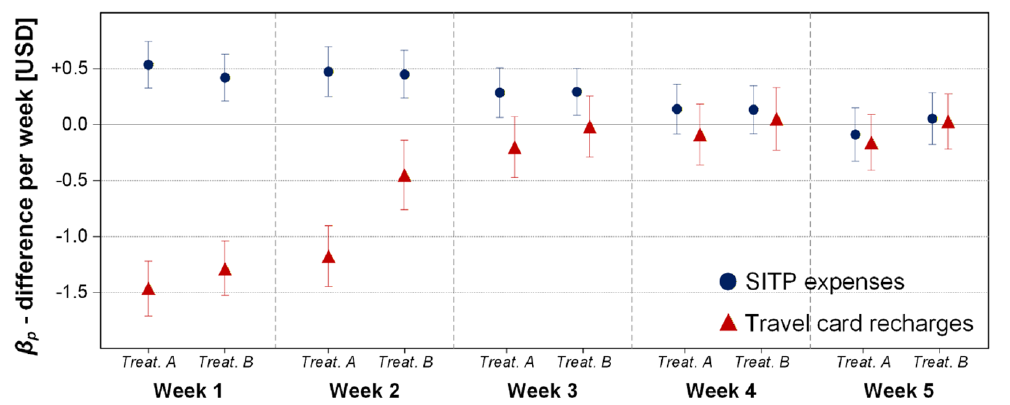
\(Y_{it}\) measures transport expenditures or travel-card recharges; \(\gamma_i\) and \(\lambda_t\) are person and week fixed effects. \(T_i^p\) marks weeks since activation, resetting with each new voucher, and \(P_i\) marks the post-treatment period. The \(\beta_p\) coefficients trace how responses evolve as the voucher is spent.
Selected results
Spending and recharges after activation
Spending beyond the estimated income effect
- Timing: in the first week, expenditures rise by about USD 0.53 for group A and USD 0.42 for group B. By week four, the increases are no longer statistically significant.
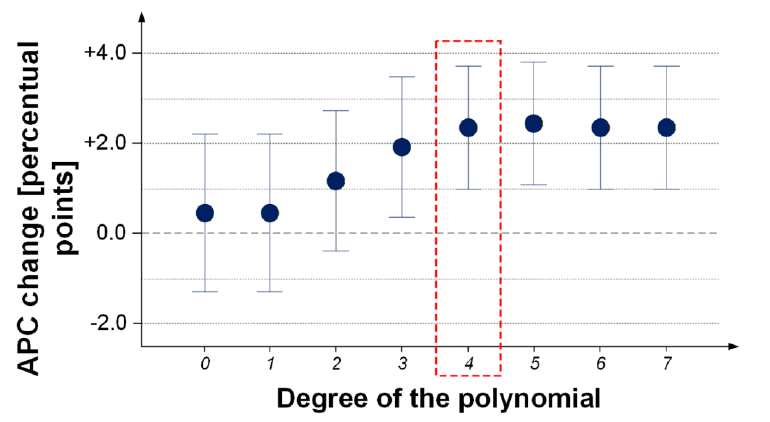
- Budget allocation: the preferred model estimates a 2.4 percentage-point increase in the transport expenditure share beyond the modeled income effect.
- Comparison: grocery vouchers do not produce a detectable increase in transport expenditures. Together, these patterns support the paper’s mental-accounting explanation.
Citation
@article{GomezCardonaGuzmanOchoaRincon:2026,
    title = {Public transport vouchers to enhance ridership: Mental accounting bias in frequent public transport users},
    author = {Gómez Cardona, Santiago and Guzman, Luis A. and Ochoa Rincón, Jorge Luis},
    doi = {10.1016/j.socec.2026.102595},
    journal = {Journal of Behavioral and Experimental Economics},
    year = {2026},
    volume = {123},
    pages = {102595}
}