
Abstract
Short summary of the published abstract. A randomized trial with 1,607 frequent users of Bogotá’s Integrated Public Transport System (SITP) evaluates monthly vouchers credited to travel cards. A mixed logit model connects changes in transport choices to consumer surplus. Vouchers increase welfare and encourage use of faster BRT services; gains differ by voucher amount, gender, and trip purpose.
Empirical strategy
Users were randomly assigned to a control group or monthly vouchers of COP 28,000 (A, about USD 7.50) or COP 21,000 (B, about USD 5.60). Weekly travel diaries record costs, travel times, and mode choices. A mixed logit model allows cost and time preferences to vary across people. Model-implied consumer surplus is then evaluated using a two-stage difference-in-differences estimator that accounts for differences in voucher activation timing. Welfare estimates depend on the choice model as well as the experimental variation.
Main equation
The observed utility of mode \(j\) for person \(i\) in week \(t\) is specified as in Equation (2):
\[ V_{ijt}=\beta_{ci}C_{jt}+\beta_{ti}T_{ijt} +\beta_{vj}\,\mathrm{treat}_i+\boldsymbol{\beta}'_j X_{ij}. \]
Here, \(C\) is monetary cost, \(T\) is travel time, and \(X\) contains individual and mode-specific attributes. Cost and time coefficients vary across people; the voucher coefficient varies across modes. A log-sum measure converts estimated utility into consumer surplus.
Selected results
Monthly welfare gains
| Voucher group | All participants | Work trips | Non-work trips | Women | Men |
|---|---|---|---|---|---|
| Pooled | 12.8 | 5.6 | 26.7 | 21.2 | 16.6 |
| A: USD 7.50 | 15.6 | 7.9 | 30.8 | 24.7 | 18.5 |
| B: USD 5.60 | 10.2 | 3.4 | 22.5 | 17.5 | 14.9 |
Travel-time changes
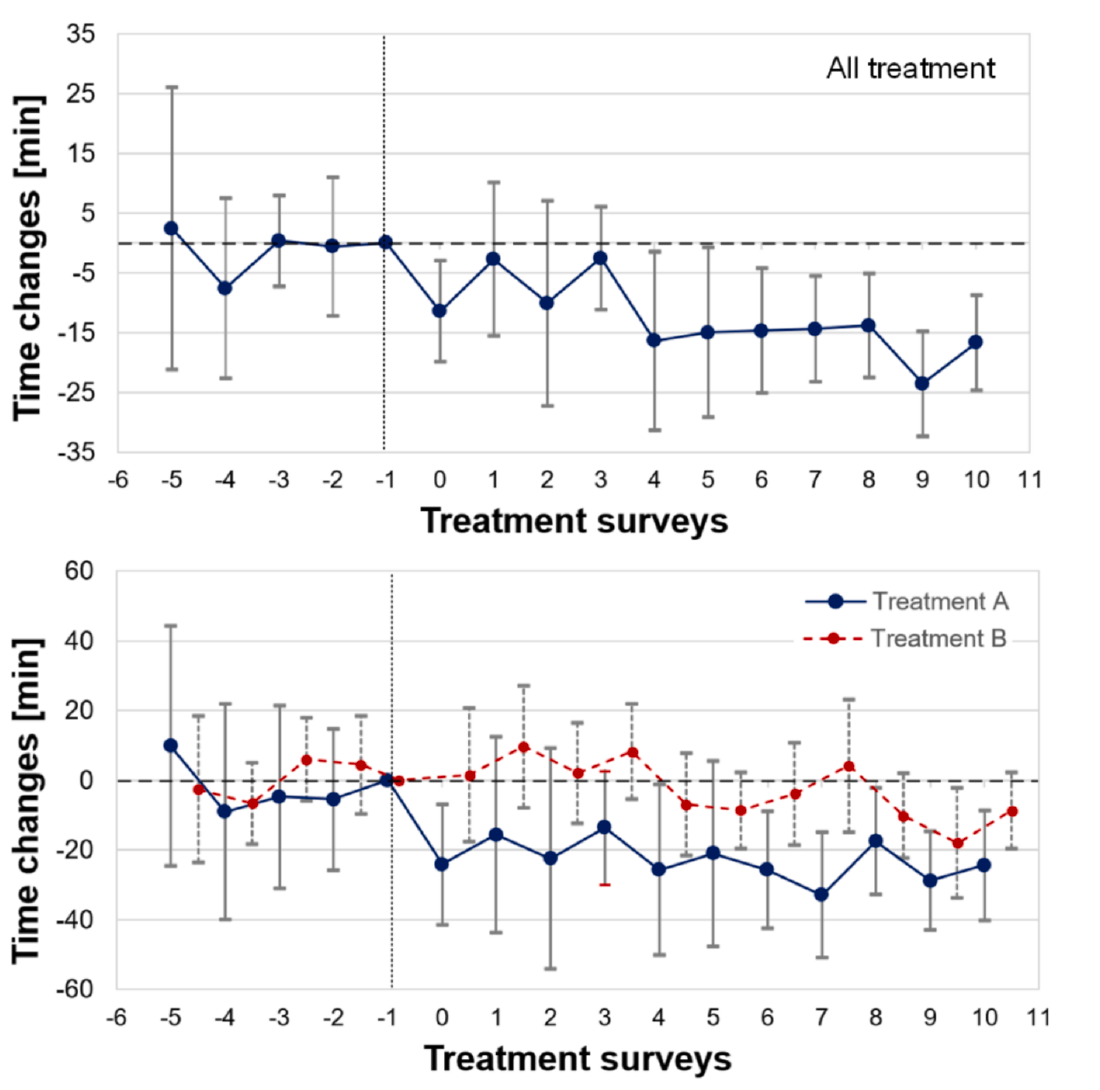
- Welfare: the average monthly gain is about 3.1% of mean household income. Non-work trips generate nearly five times the gain of work trips.
- Distribution: women gain USD 4.6 more per month than men, even though their baseline benefits from transport choices are lower.
- Mechanism: modal share shifts toward BRT, and time savings grow with exposure. The smaller voucher does not yield clear evidence of travel-time reductions. Transport supply was unchanged during the experiment.
Citation
@article{GuzmanOchoaGomezCardonaSarmientoBarbieri:2025,
    title = {Pro-poor transport subsidies: More user welfare and faster travel},
    author = {Guzman, Luis A. and Ochoa, Jorge Luis and Gómez Cardona, Santiago and Sarmiento-Barbieri, Ignacio},
    doi = {10.1016/j.tra.2025.104454},
    journal = {Transportation Research Part A: Policy and Practice},
    year = {2025},
    volume = {195},
    pages = {104454}
}